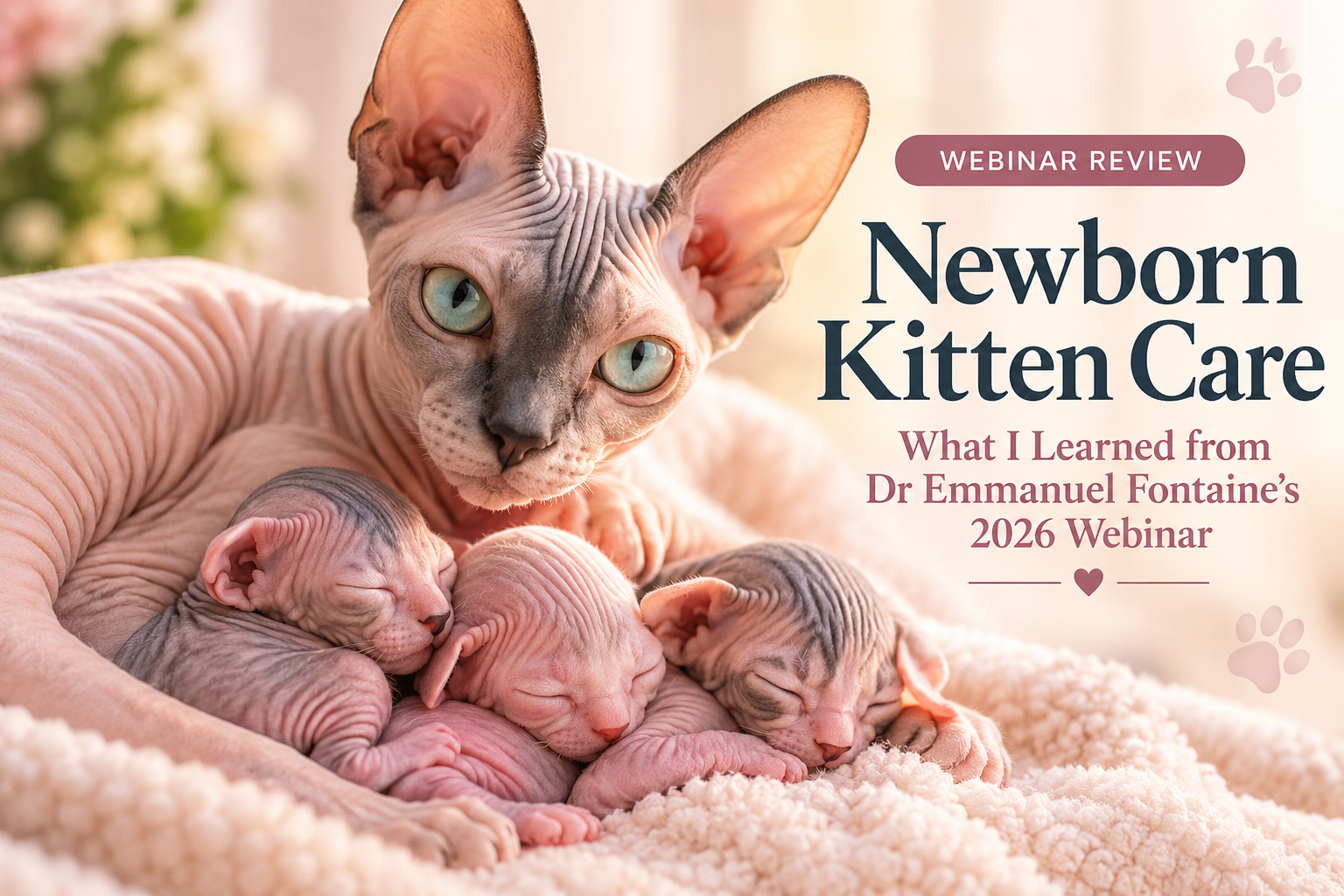
Newborn Kitten Care: What I Learned from Dr Emmanuel Fontaine's 2026 Webinar
New research, changing advice and why even experienced breeders should never stop learning.
As a new cat breeder, I want to give my kittens the very best possible start in life and I think this will be the same for even those who are much more experienced than I. We invest so much time, care and emotion into our breeding programmes, and when those tiny new-born kittens arrive, it's very clear that every decision we make can matter.
But one thing I have always believed is that there is always something new to learn, no matter how experienced you are.
On 10 October 2026, I attended a fascinating webinar presented by Dr Emmanuel Fontaine, titled Newborn Kitten Care: The 2026 Update, sponsored by Purina Pro Plan.
The webinar explored some of the latest research and recommendations surrounding neonatal kitten care. What made it particularly interesting was that several of the points discussed challenged advice that has traditionally been passed down among breeders.
I wanted to share some of the key things I took away from the webinar, as I think they are important considerations for anyone involved in breeding and raising kittens.
1. Newborn Kitten Resuscitation: Some Traditional Practices Are Changing
One of the most interesting parts of the webinar concerned what we should do when a kitten is born and isn't immediately breathing or responding as expected.
For years, certain techniques have been commonly discussed among breeders, including suctioning a kitten's nose and mouth or swinging a kitten to help remove fluid.
However, Dr Fontaine explained that routine suctioning is no longer recommended, as it can irritate the delicate airways and potentially trigger a reflex that slows the kitten's heart rate.
He was also very clear that kittens should never be swung to remove fluid, as this can cause serious injury, including bleeding within the brain.
Instead, the initial focus should be on:
- Drying the kitten promptly with warm towels to prevent heat loss.
- Assessing breathing, movement, muscle tone and colour.
- Identifying whether the kitten is vigorous or needs additional help.
- Prioritising effective breathing and oxygenation.
He also discussed assisted ventilation using a neonatal bag and mask, explaining that room air can be used rather than automatically reaching for concentrated oxygen.
Importantly, he emphasised that these techniques require appropriate veterinary training, as incorrect ventilation pressures can damage a newborn kitten's lungs.
My takeaway: Having the right equipment is only part of being prepared. Knowing how and when to use it safely is equally important. It is worth discussing a neonatal emergency plan with your vet before a litter arrives.
2. Apgar Scoring: A Simple Way to Identify Kittens That Might Need Extra Attention
Another recommendation that stood out was the use of Apgar scoring in newborn kittens.
This is a structured way of assessing a kitten's condition after birth by looking at five characteristics:
- Heart rate
- Breathing
- Gum colour
- Movement and muscle tone
- Reflex response
Dr Fontaine explained that kittens can be given a score out of ten, with lower scores indicating that they may require closer monitoring or urgent veterinary attention.
What I found particularly interesting was his emphasis on kittens scoring between 4 and 6.
These kittens may not appear severely compromised at first glance, but they could still be struggling and need additional observation.
He recommended assessing kittens at 5, 30 and 60 minutes after birth, rather than relying on a single initial assessment.
Ideally, scores should improve as the kitten adjusts to life outside the womb. A declining score should raise concern.
My takeaway: It is easy to concentrate on the obviously weak kitten, but the ones that seem reasonably well may also need watching. Recording Apgar scores could provide a more consistent way of identifying those kittens early. See our Sphynx Care page for a copy of the APGAR score for kittens.
3. The Mother Is the First Medical Intervention
This was probably one of my favourite messages from the webinar.
Dr Fontaine emphasised that giving kittens the best possible start actually begins well before they are born.
The health, nutrition, condition and environment of the mother — often referred to as the queen — can all influence the health and survival of her kittens.
Nutrition during pregnancy and lactation
He recommended feeding a suitable growth or kitten diet throughout pregnancy and lactation, ensuring that the queen receives the additional energy and nutrients she needs.
During lactation, her energy requirements may increase to approximately two to three times her normal daily needs.
He also highlighted the importance of providing plenty of fresh water, monitoring her weight regularly and ensuring that she maintains an appropriate body condition.
Creating a calm maternity environment
Another point was the importance of introducing the queen to her maternity area around one to two weeks before her kittens are due.
A familiar, quiet and consistent environment can help minimise stress.
He also discussed the possible use of feline pheromone diffusers to support relaxation and maternal behaviour.
The maternal microbiome
Something else I found particularly interesting was the discussion about the mother's gut microbiome.
Dr Fontaine explained that mothers transfer important bacteria to their kittens, helping establish their developing gut microbiome.
He suggested that feeding the queen the same suitable growth diet that her kittens will eventually be weaned onto may help make the transition to solid food smoother.
He also discussed probiotics, although he made clear that some of their proposed benefits are still being investigated.
My takeaway: Good neonatal care doesn't begin at birth. It starts with how we prepare and care for our queens throughout pregnancy.
4. Daily Weighing: A Particularly Important Change in Advice
This was one of the biggest points I took away from the webinar.
Traditionally, breeders have sometimes been told that newborn kittens can lose up to 10% of their birth weight in the first 24 hours and that this is normal.
However, Dr Fontaine explained that more recent kitten-specific evidence does not support automatically accepting this early weight loss as normal.
His advice was clear:
Newborn kittens should ideally be gaining weight every day.
He recommended weighing kittens at birth and then daily, keeping accurate records and using appropriate kitten growth charts. You can find a copy of the growth charts I will be using here.
A kitten that loses weight, or whose weight remains static, should be assessed more closely rather than having the change dismissed as normal.
He did mention an exception for some low-birth-weight kittens, which may maintain their weight during the first couple of days without necessarily indicating a problem. However, weight gain remains preferable.
Can kittens gain weight too quickly?
Interestingly, Dr Fontaine also discussed the opposite problem.
We often celebrate a kitten that gains weight particularly quickly, but he explained that excessively rapid growth may also be associated with health concerns.
He discussed possible links with swimmer kitten syndrome, flat-chested kittens and later obesity.
This is why he recommended looking at growth trends and centile charts, rather than simply aiming for the highest possible weight gain.
My takeaway: The aim isn't to produce the biggest kitten or the fastest-growing kitten. It is to support steady, healthy, appropriate development.
5. Remember the Three Hs
Dr Fontaine also discussed three important problems that can contribute to a newborn kitten deteriorating.
These are sometimes referred to as the three Hs:
Hypothermia — when a kitten's body temperature becomes too low.
Hypoglycaemia — when blood glucose levels become dangerously low.
Hypovolaemia — when the kitten has insufficient circulating fluid volume, often associated with dehydration.
Newborn kittens are particularly vulnerable because they have limited reserves and cannot regulate their body temperature effectively.
He explained that these problems, alongside inadequate oxygenation, can affect the intestinal barrier and potentially contribute to bacteria entering the bloodstream, increasing the risk of sepsis.
One useful point was that the traditional skin-pinching method of checking dehydration is unreliable in newborn kittens.
My takeaway: When a newborn kitten isn't thriving, it is important to look at the whole picture rather than assuming that an infection is responsible. A weak or deteriorating kitten needs prompt veterinary assessment.
6. Antibiotics Are Not Always the Answer
Another important discussion concerned the use of antibiotics in newborn kittens.
Dr Fontaine cautioned against giving antibiotics routinely or simply 'just in case'.
He explained that unnecessary antibiotic use can disrupt the developing gut microbiome and contribute to antibiotic resistance.
He also referred to research suggesting an association between early antibiotic exposure and an increased risk of chronic gastrointestinal problems later in life.
It is important to note that an association does not necessarily prove that antibiotics caused those problems.
His message was not that antibiotics should never be used. They can be essential when clinically indicated.
Instead, he encouraged breeders and veterinarians to investigate the underlying cause of illness and use medication appropriately.
My takeaway: More intervention does not always mean better care. Sometimes the most important thing is understanding why a kitten is struggling before deciding on treatment.
7. A Few Other Interesting Points from the Questions and Answers
There were also some useful points raised during the Q&A session.
Umbilical cords: Dr Fontaine discussed waiting approximately three minutes before cutting the cord when circumstances allow, to potentially support additional placental blood transfer. He noted that the supporting research discussed came from puppies, so this should not be treated as established kitten-specific evidence.
Oxytocin: He stressed that oxytocin should only be administered under veterinary supervision, particularly because an obstruction must be ruled out first.
Incubators: While incubators can be extremely useful, particularly for orphaned kittens, he explained that healthy kittens with an attentive mother are generally best returned to her care.
Placental rubbing: He advised against rubbing kittens with the placenta, as this makes them wet and can increase heat loss.
These are all useful reminders that neonatal care is continually developing as more research becomes available.
What Will I Take Away from This Webinar?
If I had to narrow the webinar down to a few key lessons, they would be these:
- Be prepared before the kittens arrive. Good maternal nutrition, a calm environment and an emergency plan are essential.
- Keep learning about neonatal resuscitation. Some traditional techniques are no longer recommended, and proper training matters.
- Weigh every kitten, every day. Accurate records and growth charts can help identify potential problems before they become obvious.
- Look beyond medication. Understanding the underlying causes of illness and focusing on prevention can make a real difference.
- Never assume that what we have always done is necessarily the best approach. As research develops, our practices should develop too.
Final Thoughts
I found Dr Fontaine's webinar incredibly interesting and thought-provoking.
For me, one of the most valuable things about attending educational webinars like this is being reminded that breeding is a constant learning process.
Even practices that have been widely accepted for many years can change when new evidence becomes available.
As responsible breeders, I believe we have a duty to keep ourselves informed, question outdated advice and continually look for ways to improve the care we provide to our cats and kittens.
After all, every litter deserves the very best start we can give them.
A huge thank you to Dr Emmanuel Fontaine for sharing his knowledge and research, and to Purina Pro Plan for sponsoring the webinar.
Please note: This blog reflects my personal notes and understanding of Dr Fontaine's presentation. It is intended to share educational information with fellow breeders and should not replace individual veterinary advice, appropriate neonatal training or emergency veterinary care.