My first Sphynx - Where I went wrong
The story of Frankie, the little kitten who stole our hearts, and the lessons I wish I'd known before bringing him home.
Five years ago, I developed a fascination with the Sphynx breed. There was just something about these unusual, beautiful, hairless cats that completely captivated me. Their appearance, their personalities, their quirky little ways – I was absolutely smitten before I'd even met one in person.
My husband, on the other hand, wasn't quite so enthusiastic! Despite his initial reservations, we eventually agreed that we would welcome a Sphynx into our family. Little did we know just how much that decision would change our lives, or how heart-breaking our first experience of owning a Sphynx would turn out to be.
How It All Began
I was actually away on holiday when I spotted an advert on my local Facebook sales page. A woman who lived around 75 miles away was advertising Sphynx kittens for sale. Now, living in a fairly rural part of the country, 75 miles seemed relatively local to me! I was immediately interested. I messaged the lady, and we exchanged a few messages about the kitten. One of the things I specifically asked about was whether the kitten would be vaccinated and neutered before coming home. The lady explained that she hadn't been able to get an appointment at her vets to have either of these things done. Even though it was still going to be approximately two weeks before I collected the kitten, she maintained that she couldn't get him booked in.
I remember having a little niggling feeling that something wasn't quite right. Surely two weeks was enough time to arrange a veterinary appointment? But I accepted her explanation. Looking back now, that was probably the first warning sign I chose to ignore.
I was excited, I wanted this kitten, and I suppose I believed what I wanted to believe. Before I knew it, I had arranged to collect my very first Sphynx kitten just two days after returning home from holiday.
I Thought I'd Done My Research
At the time, I genuinely believed I'd done a reasonable amount of research into the Sphynx breed. I knew they required more hands-on care than your average cat. I'd read about bathing, cleaning their ears, caring for their nails and keeping their skin healthy. I felt fairly confident that I understood what owning a hairless cat involved.
But what I hadn't properly researched was arguably the most important thing of all.
Health, HCM, and what it actually means to buy a kitten from an ethical, responsible breeder.
I knew very little about Hypertrophic Cardiomyopathy (HCM), a heart condition that is particularly important in the Sphynx breed. I didn't understand the importance of regular heart screening of breeding cats by a veterinary cardiologist. I didn't know what health documentation I should expect to see, or what questions I should be asking about the kitten's parents. I also didn't really understand what separated a responsible breeder from someone who was simply producing kittens to sell. And, as I was about to discover, there is a very big difference.
Meeting My First Sphynx – At McDonald's!
Two days after returning home from holiday, the day finally arrived to collect my kitten. But rather than visiting the breeder's home, meeting the kitten's mother, seeing where he had been raised and observing him with his littermates, I arranged to meet the lady at McDonald's. Yes, McDonald's! I can almost hear experienced breeders and Sphynx owners gasping as they read that. And believe me, knowing what I know now, I cringe a little myself.
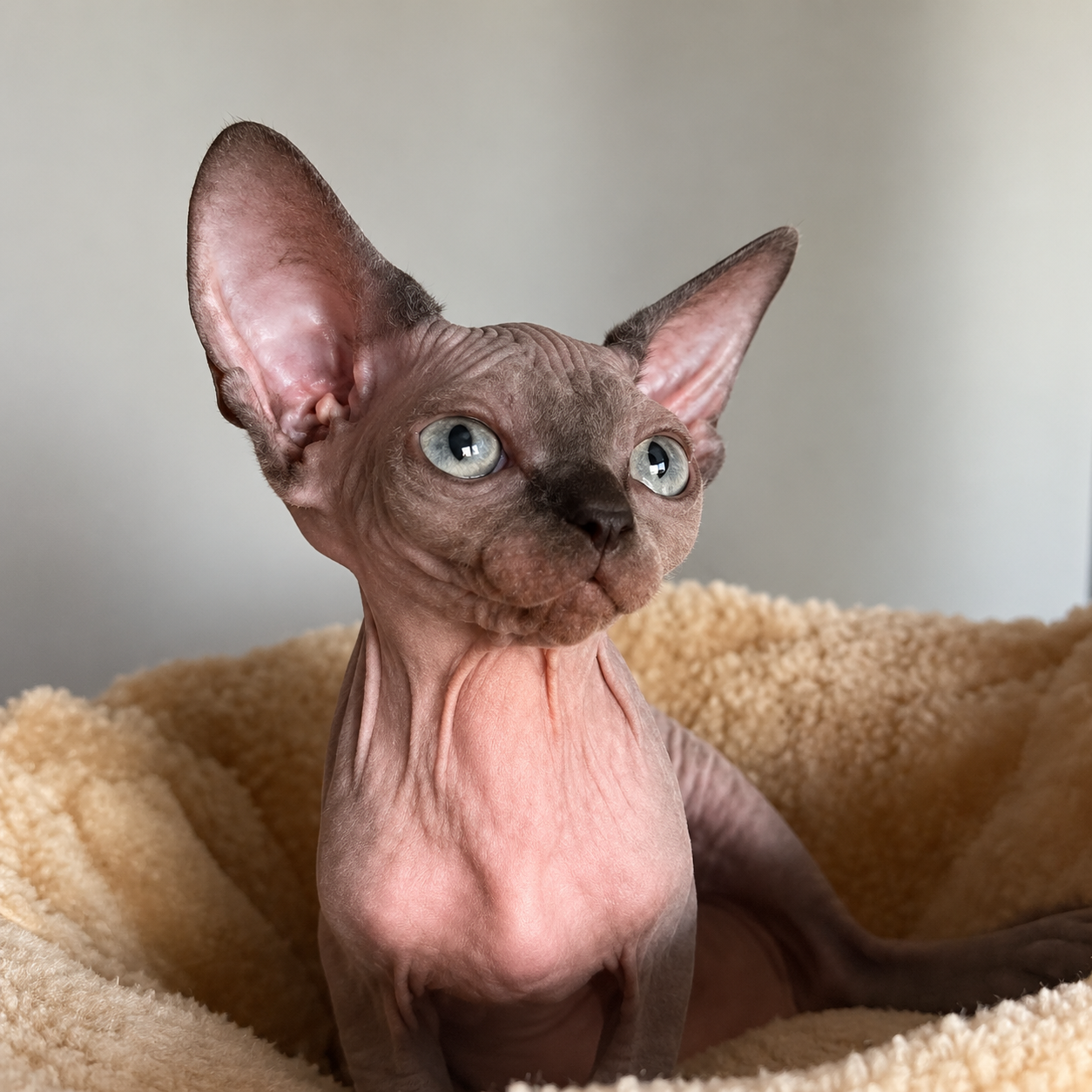
The lady arrived and handed me this absolutely beautiful little kitten. We called him Frankie. He was tiny, unusual, and completely adorable. We fell in love with him instantly. There was no registration paperwork, no evidence of health checks, no health guarantees, and no vaccination records. He hadn't been neutered or vaccinated. I hadn't seen his mother, his littermates, or the home in which he had been raised. I had very little information about where he had come from. And yet I took him home, absolutely delighted with my beautiful new kitten.
Was Frankie Even Old Enough to Leave His Mum?
Looking back, one of the things that troubles me now is just how small Frankie was. At the time, I didn't question it. He was a kitten, after all, and kittens are supposed to be small.
But with the experience and knowledge I have gained since, I now wonder whether Frankie was actually only around eight weeks old when I collected him. Perhaps even more concerning, I sometimes wonder whether there was something congenitally wrong with him that none of us knew about. He certainly looked quite different from the Sphynx cats I have today, and when I think back to his behaviour, he wasn't nearly as energetic or playful as my own kittens have been.
Of course, every kitten is an individual, and I can't say for certain that anything was wrong. But knowing what I know now, I do wonder. Was he simply a quieter little kitten? Was he younger than I'd been told? Or were there signs of an underlying health problem that I didn't recognise? These are questions I will never have the answers to.
Bringing Frankie Home
Within two days of bringing Frankie home, I took him to my local veterinary practice. We started his vaccinations and arranged for him to be neutered approximately four weeks later. I wanted to make sure we did everything properly for him. And for a while, everything seemed absolutely wonderful. Frankie settled into our home and into our hearts. My husband, who had initially been so reluctant about getting a Sphynx, was completely won over. We both fell head over heels in love with our quirky little guy. He was different, he was special, and he had this wonderful way of making himself the centre of our world. Everyone who met him loved him.
There is something about a Sphynx that is incredibly difficult to explain until you've owned one. They aren't just cats. They have such enormous personalities and a way of becoming completely involved in every part of your life and Frankie was no exception. He held a very special place in both our hearts, and we absolutely adored him. We imagined all the years we would have with him, all the funny little things he would do, and all the memories we would make together. Sadly, we were never going to have that time.
The Day Our Hearts Broke
We had only had Frankie for around two months when our world came crashing down. I received a phone call from my husband. He had been outside mowing the grass and had come back into the house to find our little Frankie lying on the utility room floor. He was dead. He was already cold, and it looked as though he had vomited a little.
I can still remember the absolute shock and disbelief. How could this have happened? He had seemed perfectly fine that morning. There had been no obvious warning that anything was wrong. One minute we had our beautiful, much-loved little kitten, and the next he was gone.
We were absolutely distraught. My husband was devastated, and so was I. I remember asking myself over and over again: What on earth had happened? Had we missed something? Was there something wrong with him that we should have noticed? Could we have done anything differently? It was heart-breaking. Frankie had only been part of our lives for such a short time, but the space he left behind was enormous.
Why Did Frankie Die?
The truth is, I don't know. We didn't have a post-mortem examination carried out. Looking back now, perhaps we should have. At the time, we were simply devastated by the sudden loss of our little guy, and I don't think we were in the right frame of mind to think clearly about investigating what had happened. Without a necropsy, we will never know for certain why Frankie died.
Was there an undiagnosed congenital condition? Was it something cardiac? Was there another underlying health problem that hadn't been detected? I simply don't know. And I think it's important to be honest about that.
Given what I now know about HCM and the health concerns that can affect the Sphynx breed, I naturally wonder whether his death could have been heart-related. But I cannot say that it was. There are many possible causes of sudden death in a young kitten, and without an investigation it would be wrong to assume any particular diagnosis.
What I do know is that we lost a much-loved little kitten far too soon, and the uncertainty surrounding his death has stayed with me ever since.
The Breeder's Response – Or Lack of One
After Frankie died, I contacted the woman who had sold him to me. I messaged her through Facebook and explained what had happened. I told her that our beautiful little kitten had died suddenly, just a couple of months after we brought him home. I suppose I hoped for some sort of response. Perhaps some sympathy, some concern, or even a conversation about what might have happened. After all, she had bred and sold this little kitten to us. I also hoped that she might want to know, particularly if there was any possibility that his death was connected to an inherited or congenital condition.
But I heard absolutely nothing. Not a single reply. No acknowledgement of my message. Nothing.
I found that incredibly upsetting and with everything I have learned since, I find it even more difficult to understand. For me, responsible breeding doesn't end the moment a kitten leaves for its new home. A breeder should care about the kittens they produce throughout their lives. They should want to know if something goes wrong, particularly when a kitten dies unexpectedly at such a young age. Not only out of compassion for the family who has lost their pet, but because information about possible health problems can be incredibly important when making future breeding decisions. The complete lack of response left me feeling terribly disappointed. We had lost Frankie, and we were left with no answers.
Looking Back – The Mistakes I Made
It's not particularly comfortable admitting how many mistakes I made when buying my first Sphynx. But I think it's important to talk about them. I bought a kitten from someone I had never met, without visiting their home or seeing the conditions in which he had been raised. I accepted an explanation about vaccinations and neutering that I wasn't entirely comfortable with. I collected him from a McDonald's car park. I didn't receive registration paperwork, health documentation or guarantees. I didn't know enough about HCM screening or the health history of his parents. I didn't properly question his age or whether he was ready to leave his mother. And perhaps most importantly, I allowed my excitement about owning a Sphynx to override that little voice telling me to ask more questions.
I don't share this to suggest that every kitten without paperwork will become ill, or that Frankie's death was necessarily caused by the circumstances in which he was bred or sold. I have no evidence to say that. But I do know that I purchased him without the information, reassurance and transparency that I would now consider essential.
I didn't know what I didn't know and I suspect there are many first-time Sphynx owners who find themselves in exactly the same position.
What Frankie Taught Me About Responsible Breeding
Frankie's short life had an enormous impact on us. He was our first Sphynx, and although we only had him for a couple of months, he introduced us to a breed that we would come to love deeply. But losing him also left me with so many unanswered questions. As I began to learn more about the breed, particularly the importance of health screening and responsible breeding, I started to realise just how much I had overlooked when buying him. I began to understand why reputable breeders invest so much time, money and emotion into the health and welfare of their cats.
- Why HCM screening matters.
- Why knowing the health history of a kitten's parents matters.
- Why kittens should be raised in a loving home, properly socialised, and given the best possible start in life.
- Why vaccinations, veterinary care, appropriate neutering arrangements and accurate documentation are so important.
- And why a responsible breeder should always be there for the families who welcome their kittens into their homes, not just on collection day, but throughout the kitten's life.
I also came to understand that even the most responsible breeder cannot guarantee that a kitten will never develop a health problem. HCM screening is an important tool, but it cannot eliminate every risk, and a clear heart scan today does not guarantee that a cat will never develop HCM in the future. However, there is a world of difference between doing everything reasonably possible to protect the health of the kittens you breed and simply hoping for the best.
Responsible breeding is about making informed decisions, being transparent, putting the welfare of your cats first, and taking responsibility for the lives you bring into the world.
These are things I feel incredibly strongly about today.
How Frankie Helped Shape RiviaSphynx
I often think about little Frankie and how different things might have been if I'd known then what I know now. Perhaps the outcome would have been exactly the same. We will never know.
But I do know that I would have approached buying him very differently. I would have asked more questions. I would have wanted to see health screening results, meet his mother, understand his background and know that the person breeding him genuinely cared about his future. I would have taken my time rather than allowing my excitement to make the decision for me. And I certainly wouldn't have collected him from a McDonald's car park!
Frankie's story is one of the experiences that helped shape my approach to breeding at RiviaSphynx. I know what it feels like to be the excited new owner, desperate to bring home that beautiful little kitten. But I also know the heartbreak of losing one. I know what it feels like to have unanswered questions, to wonder whether you missed something, and to receive no response from the person who bred your kitten when you desperately need some reassurance. It is an experience I would never wish on anyone. And it is one of the reasons I believe so strongly in being open and honest with prospective kitten owners, educating them about the breed, discussing health concerns and making sure they understand the responsibilities that come with owning a Sphynx. I want people to feel comfortable asking questions. In fact, I actively encourage it. Because someone who has done their research and asks lots of questions isn't being difficult. They're being responsible.
My Advice to Anyone Buying Their First Sphynx
If you're reading this because you're thinking about welcoming your first Sphynx into your family, please learn from my mistakes.
- Don't rush into buying a kitten simply because you've fallen in love with a photograph.
- Take the time to research the breeder, not just the breed.
- Ask about HCM screening, request evidence of health testing, and find out about the health history of the kitten's parents.
- Visit the breeder, meet the kitten's mother and see the environment in which the kittens are being raised.
- Make sure you understand what veterinary care the kitten has received, what paperwork will be provided, and what support you can expect after taking your kitten home.
- And if something doesn't feel quite right, don't ignore that feeling. There will always be another kitten.
I know how difficult that can be to hear when you've already fallen in love, but choosing the right breeder is every bit as important as choosing the right kitten. A beautiful kitten isn't necessarily a responsibly bred kitten. And while responsible breeding cannot guarantee a lifetime of perfect health, it can give kittens a better start and owners the confidence that appropriate care and precautions have been taken.
Frankie – The Little Boy We Will Never Forget
Five years on, I still think about Frankie. I think about how tiny he was, how much we loved him, and how quickly he became such an important part of our family. I think about my husband, who hadn't really wanted a Sphynx in the first place, becoming completely besotted with our funny little boy. And I think about how terribly unfair it felt that we had so little time with him. We will never know why Frankie died. Perhaps there was something wrong with him from birth. Perhaps his death was completely unrelated to his breeding or the circumstances in which we bought him. Those questions will always remain unanswered.
But what I do know is that Frankie was loved, completely and unconditionally, for every single day he was with us. And although his life was heartbreakingly short, his impact on ours was enormous. He was the beginning of our love affair with this wonderful breed, and his memory continues to influence the way I think about the health, welfare and future of the Sphynx.
I can't change the mistakes I made when buying Frankie, and I can't bring him back. But I can use what I've learned to help other people make more informed decisions.
If sharing his story encourages even one person to research a breeder more thoroughly, ask about HCM screening, or walk away from a situation that doesn't feel right, then something positive will have come from our heartbreak.
Frankie may only have been with us for a couple of months, but he will always hold a very special place in our hearts. He was our first Sphynx. He was our little Frankie. And in many ways, he was where the RiviaSphynx journey truly began.
Sleep tight, little Frankie. You were loved more than you'll ever know.
Jackie RiviaSphynx
Sharing our experiences, our love for the breed, and our commitment to responsible Sphynx breeding.